

Are Rooftop Tents Dying? We Don't Think So. Here's Why.
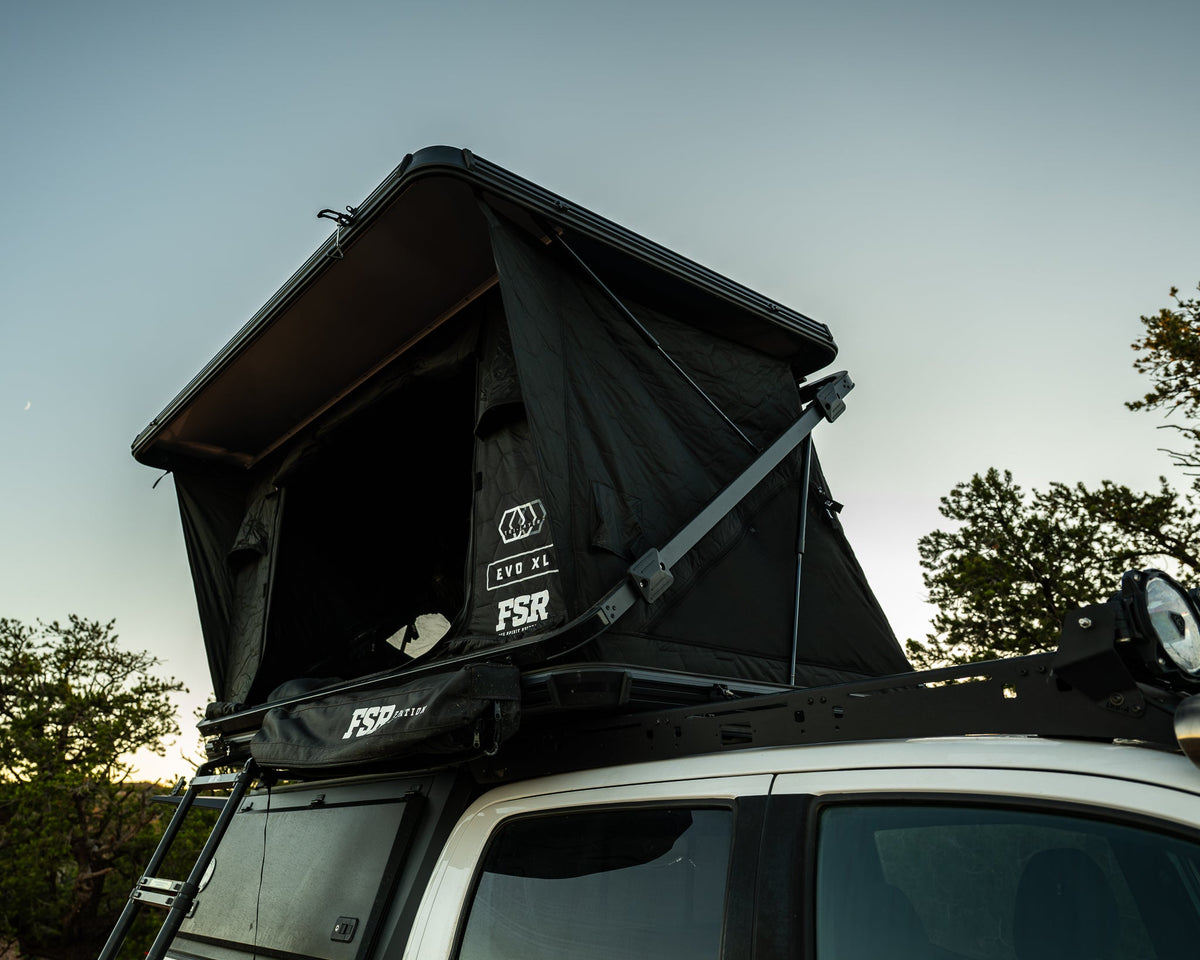
Are Rooftop Tents Dying? We Don't Think So. Here's Why.
If you've spent any time around the overlanding world lately, you've probably heard the question:
Are rooftop tents dying?
There are more ground tents, truck bed campers, trailers, and alternative camping setups than ever. The rooftop tent market has also become crowded, with more brands, more price points, and more options than most people could have imagined a few years ago.
And sure, some people are moving away from rooftop tents.
But are rooftop tents actually dying?
We don't think so.
We think the rooftop tent is simply entering a new phase.
The days of buying any RTT, bolting it to the top of your rig, and calling yourself an overlander may be fading. But the fundamental reasons people bought rooftop tents in the first place haven't gone anywhere.
In fact, for the right kind of adventurer, an RTT can still be one of the best pieces of gear you can put on your vehicle.
Here's why.
Rooftop Tents Solve a Real Problem
At their core, rooftop tents aren't about looking cool on Instagram.
They're about making camping easier.
You drive into camp, park, open the tent, climb the ladder, and you're ready to sleep. Your mattress is already there. Your sleeping setup is already organized. You don't have to find a perfectly flat patch of dirt, clear rocks and sticks, or spend the evening crawling around on the ground trying to get your tent pitched.
That's a pretty compelling proposition.
And the faster setup becomes even more valuable when you're arriving at camp late, dealing with bad weather, or trying to squeeze a weekend adventure into a limited amount of time.
Modern hardshell RTTs have pushed this convenience even further, with many designed to deploy extremely quickly.
The best gear doesn't necessarily make an adventure more complicated.
It removes complications.
That's where rooftop tents still shine.
The Overlanding Market Is Changing—Not Disappearing
There is a legitimate reason people are asking whether RTTs are dying.
The market is crowded.
There are now countless rooftop tent manufacturers competing for the same customer, and SEMA has pointed out that the category has become saturated, particularly at the lower end of the market. At the same time, manufacturers are continuing to develop larger, more comfortable and faster-deploying tents.
That's an important distinction.
A saturated market isn't necessarily a dying market.
It can mean consumers have more choices.
It can also mean they're becoming smarter about what they buy.
Instead of simply asking, "Does my rig need a rooftop tent?"
People are starting to ask better questions:
-
How often am I actually camping?
-
How much weight can my vehicle handle?
-
Do I want a hardshell or softshell?
-
Do I move camp every night?
-
Do I need to leave my campsite during the day?
-
How much space do I actually need?
-
Is an RTT the best shelter for the way I travel?
That's a good thing.
The goal shouldn't be to convince everyone they need a rooftop tent.
The goal should be to help people find the right setup for the way they adventure.
RTTs Are Still Hard to Beat for Mobile Camping
There's a particular type of camping where rooftop tents make an incredible amount of sense.
You're traveling.
You're exploring.
You're moving from one campsite to another.
You're spending the day on trails and only need a place to sleep when the sun goes down.
That's where the RTT really comes into its own.
A traditional ground tent can be fantastic, but setting it up and breaking it down every day adds another step to an already busy adventure.
A trailer can give you significantly more space, but it also adds another piece of equipment to tow and maneuver.
A truck camper can provide even more comfort and living space, but you're making a much larger investment and adding substantially more weight and complexity.
A rooftop tent sits somewhere in the middle.
It gives you a dedicated sleeping space without turning your truck or SUV into an RV.
That's a pretty useful middle ground.
You're Sleeping Above the Ground
This might sound like one of those features that gets exaggerated in marketing.
It isn't.
Getting your sleeping area off the ground has some legitimate advantages.
You don't have to worry about sleeping directly on wet or muddy ground. You aren't searching for the perfect flat campsite. And your sleeping platform isn't affected by every rock, root or uneven patch underneath your tent.
You also get a mattress built into most RTT systems, which can make the transition from driving all day to sleeping at camp significantly easier.
And let's be honest:
After a long day on the trail, climbing into an actual mattress sounds pretty good.
Your Gear Stays Organized
Another underrated advantage of a rooftop tent is that your sleeping system essentially lives on your vehicle.
You don't have to dedicate a chunk of your cargo area to a tent, mattress, sleeping pads and other shelter components.
That space can instead be used for the things you actually need during the trip:
-
Recovery gear
-
Coolers and fridges
-
Food and water
-
Camp chairs
-
Cooking equipment
-
Tools
-
Spare parts
-
Outdoor gear
For people building a vehicle specifically for overlanding, that organization can make a huge difference.
Your truck becomes a mobile basecamp.
But Rooftop Tents Aren't for Everyone
Here's where we think the RTT conversation gets interesting.
We don't think everyone needs a rooftop tent.
In fact, there are plenty of situations where a ground tent is the better option.
If you're camping with a large family, a ground tent can give you significantly more usable living space.
If you typically stay at one campsite for several nights, a ground tent allows you to leave camp set up while you take your vehicle out exploring.
If you're trying to keep your vehicle light, an RTT adds significant weight up high.
And if you only camp once or twice a year, spending thousands of dollars on a rooftop tent may not make much sense.
Those aren't failures of the RTT.
They're simply situations where another camping system might be a better fit.
The Biggest Problem With Rooftop Tents?
We think the biggest problem isn't rooftop tents.
It's buying the wrong one.
As the market has exploded, there are more inexpensive RTT options than ever. SEMA has specifically noted concerns around market saturation and declining quality at the lower end of the category.
A rooftop tent is a major piece of equipment.
It's going on top of your vehicle.
You're going to drive hundreds or thousands of miles with it attached.
You're going to sleep in it during wind, rain, heat and cold.
You're going to open and close it repeatedly.
That's not the place to buy purely based on the lowest price.
Instead, look at:
Weight: Can your vehicle and rack safely support the tent?
Construction: Is it built for the conditions you're actually going to encounter?
Setup: How easy is it to deploy after a long day?
Sleeping capacity: Does it actually fit everyone who will be using it?
Weather protection: How does it perform in the environments where you camp?
Storage: Does it give you enough room for your sleeping gear?
Vehicle compatibility: Does the tent work with your rack and vehicle configuration?
The right RTT should make your adventures easier—not create another problem to solve.
So, Are Rooftop Tents Dying?
No.
But we think the RTT hype cycle is maturing.
People aren't necessarily looking for the biggest tent, the most expensive tent, or the tent that looks best on social media anymore.
They're asking whether the tent actually makes sense for their adventures.
And that's exactly how it should be.
The rooftop tent isn't going to replace ground tents.
It isn't going to replace truck campers.
It isn't going to replace trailers.
It doesn't need to.
A rooftop tent has carved out its own place in the outdoor world because it solves a very specific problem:
How do I build a comfortable, mobile sleeping system that lets me explore farther without turning my vehicle into a full-blown RV?
For thousands of campers and overlanders, that's still a pretty good question.
And the answer is still a rooftop tent.
The Bottom Line
We don't think rooftop tents are dying.
We think they're getting better.
The market is becoming more competitive. Consumers are becoming more educated. Manufacturers are building faster, more comfortable and more refined designs. And people are getting better at choosing camping systems based on how they actually spend time outside.
That's a win for everyone.
Because at the end of the day, the best camping setup isn't the one with the most gear.
It's the one that gets you outside more often.
If a rooftop tent makes it easier for you to throw your gear in the truck, drive into the mountains and spend a night under the stars, then it's doing exactly what it's supposed to do.
And that's why, for the right adventurer, we don't think the rooftop tent is going anywhere.
It's just getting better.
Looking for a rooftop tent?
Whether you're building your first overland rig or upgrading your current setup, the team at Spirit of 1876 can help you figure out what actually makes sense for your vehicle, your gear and the way you camp.
Stop by Spirit of 1876 and let's talk about your next adventure.
Comments